
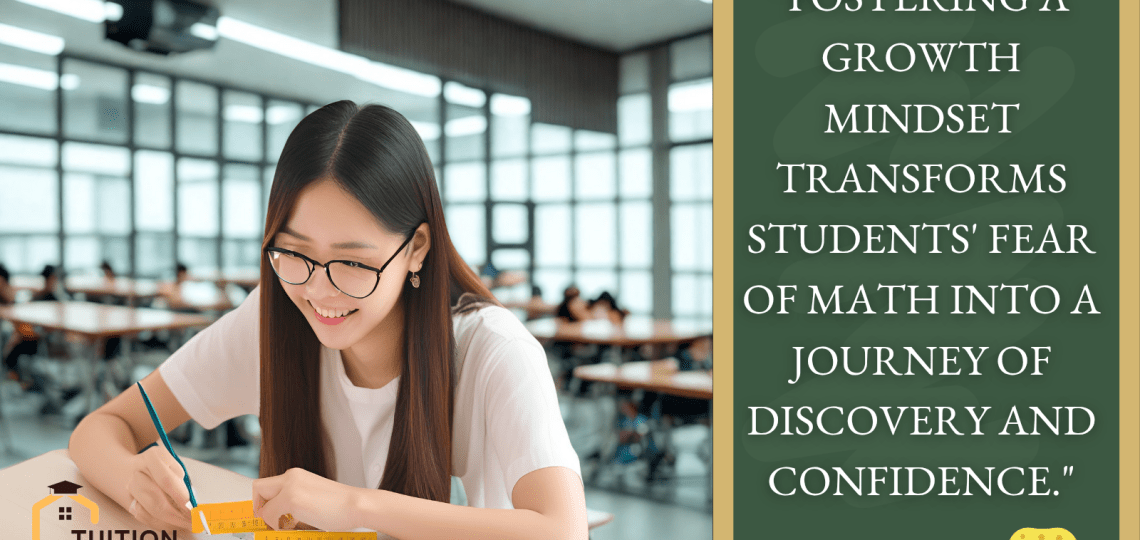
Transforming Student Perspectives on Mathematics Through Mindset and Challenge
Tuition Near Me Singapore
Mathematics is an essential skill that forms the foundation for many academic pursuits and everyday problem-solving. Yet, for a significant number of students, math can evoke feelings of frustration, anxiety, and an overall negative mindset. This emotional response can hinder not only their performance in mathematics but also their confidence in their overall academic capabilities. However, by addressing the roots of this struggle and fostering an environment that promotes a growth mindset, educators can help students shift their perspectives on math.
One of the primary reasons students struggle with math is the perception that they are either “good” or “bad” at the subject, leading to a fixed mindset. This belief leaves little room for growth or improvement. Conversely, a growth mindset encourages the idea that abilities can be developed through dedication and hard work. Teachers play a crucial role in cultivating this mindset. By sharing stories of mathematicians who faced adversity, emphasizing effort over innate ability, and celebrating mistakes as learning opportunities, educators can encourage students to embrace challenges rather than shy away from them.
In the classroom, there are numerous strategies teachers can implement to create a supportive learning environment. For instance, cooperative learning activities can foster collaboration, where students work together to solve problems. This not only enhances their mathematical understanding but also builds a sense of community. When students witness their peers struggling and succeeding together, they can better appreciate the learning process, understanding that struggle is a part of growth.
Another effective approach is incorporating real-world applications of mathematics. By connecting mathematical concepts to real-life scenarios—such as budgeting, statistics in sports, or data analysis—students can see the relevance of what they are learning. This connection can be particularly effective when introducing new topics or during virtual lessons where students might feel distanced from the content. For instance, in a virtual environment, teachers can use interactive software to create simulations that display how math is applicable in various fields, making the learning experience more engaging and relatable.
Plus, educators should offer varied levels of challenges tailored to each student’s skill level. This allows students to experience success at different stages while gradually increasing the complexity of problems they face. For example, using differentiated tasks in both in-person and virtual settings can help ensure that all students are appropriately challenged without feeling overwhelmed. Online platforms can also provide personalized learning pathways that allow students to progress at their own pace, helping them build confidence as they master each concept.
Regular feedback is essential in helping students understand their progress. Constructive feedback reinforces a growth mindset by highlighting areas of improvement while also acknowledging what the student did well. Teachers can implement digital tools in virtual classrooms to provide timely feedback on assignments or even host live Q&A sessions where students can ask questions and seek clarification, fostering a supportive learning atmosphere.
Redefining how students perceive mathematics requires a multifaceted approach, grounded in understanding and support. Through the promotion of a growth mindset, the implementation of appropriate challenges, and the creation of a collaborative learning environment—both in person and online—teachers can significantly alter students’ emotional responses to mathematics.